
Gas groups and temperature classes
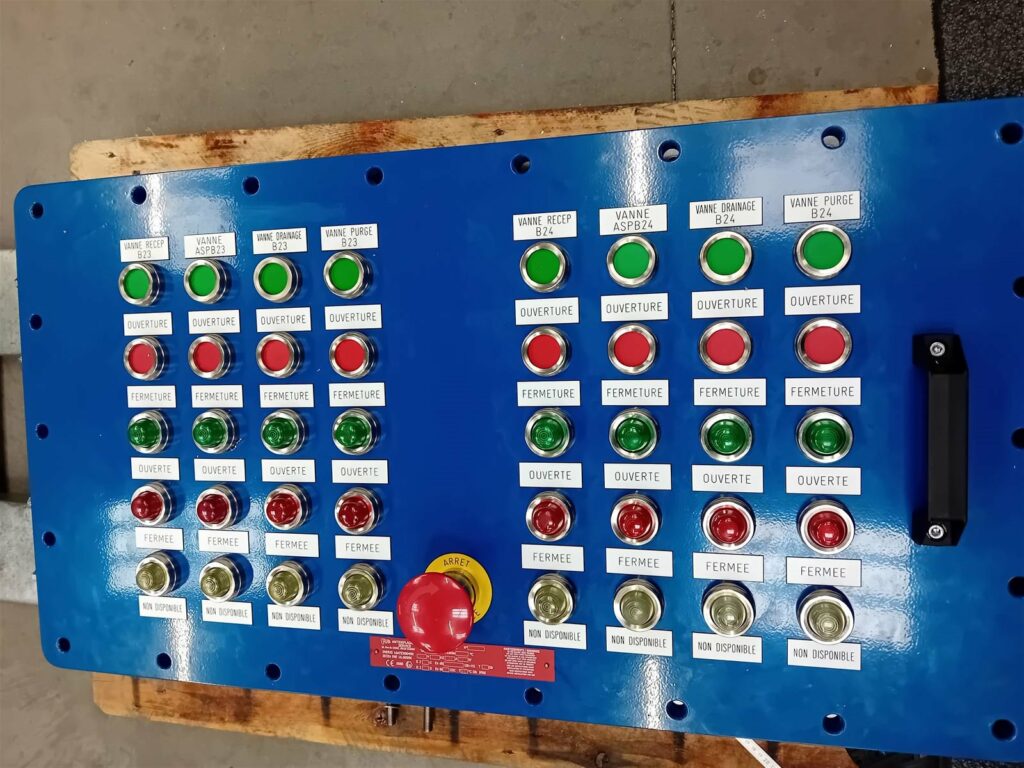
Two characteristics of the gas determine the equipment to install: how easily an explosion propagates (the group) and the temperature at which it ignites spontaneously (the temperature class).
Gas groups
| Group | Representative gas | Severity | Examples |
|---|---|---|---|
| IIA | Propane | Least severe | Propane, butane, industrial methane, petrol, acetone |
| IIB | Ethylene | Intermediate | Ethylene, ether, hydrogen sulphide |
| IIB+H2 | Ethylene and hydrogen | IIB and hydrogen | Hydrogen installations without acetylene or carbon disulphide |
| IIC | Hydrogen, acetylene | Most severe | Hydrogen, acetylene, carbon disulphide |
IIC equipment is suitable for all gases, subject to its temperature class. IIB+H2 equipment is also suitable for IIA gases. IIB equipment is suitable for IIB and IIA gases. Our IIB+H2 enclosures
Dust groups
| Group | Type of dust |
|---|---|
| IIIA | Combustible flyings (fibres) |
| IIIB | Non-conductive dusts (flour, sugar, plastics) |
| IIIC | Conductive dusts (metals, carbon) |
Temperature classes
The maximum surface temperature of the equipment must stay below the auto-ignition temperature of the gas.
| Class | Maximum surface temperature |
|---|---|
| T1 | 450 °C |
| T2 | 300 °C |
| T3 | 200 °C |
| T4 | 135 °C |
| T5 | 100 °C |
| T6 | 85 °C |
T6 equipment is suitable for all classes. For dusts, the surface temperature is given directly in degrees (for example T85 °C).