
FAQ
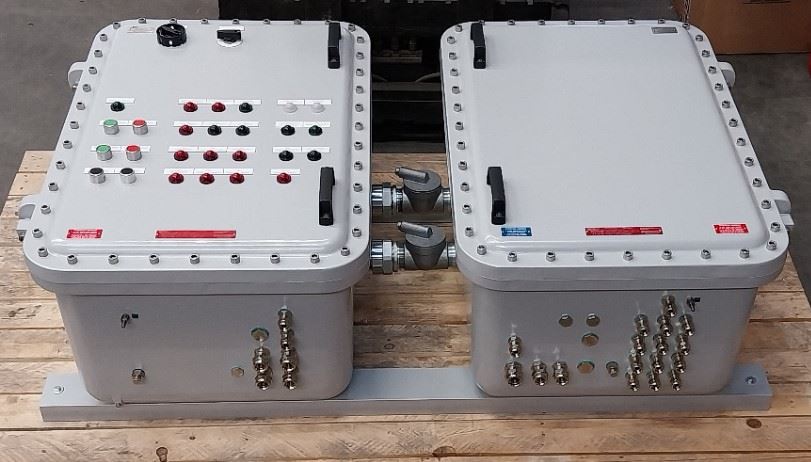
What is the difference between an Ex d and an Ex e enclosure?
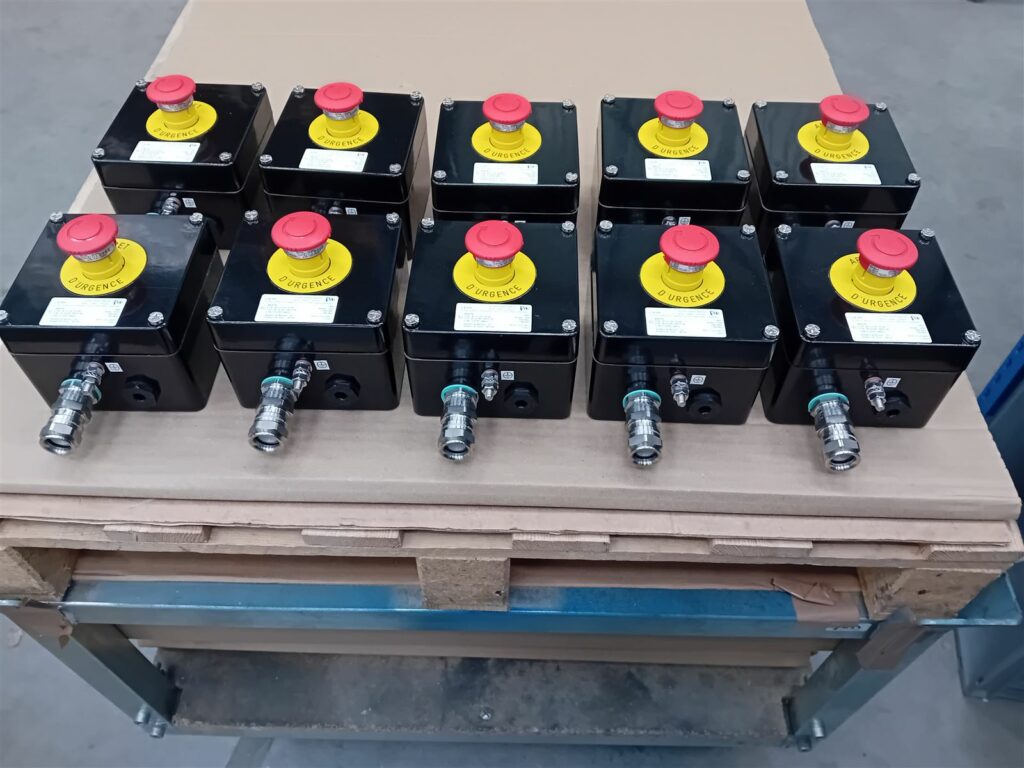
An Ex d (flameproof) enclosure can contain components that produce sparks: it withstands an internal explosion and prevents it from spreading. An Ex e (increased safety) enclosure contains terminals and components that produce no arcs or sparks in normal service, or certified components with their own protection (for example Ex d or Ex m contact blocks). Learn more
Can your enclosures be used in zone 0?
Our Ex d and Ex e enclosures are certified for zones 1, 2, 21 and 22. Zones 0 and 20 require category 1 equipment, so our enclosures are not intended for them. ATEX zones
What does IIB+H2 mean?
The equipment is suitable for group IIB gases and for hydrogen, but not for acetylene or carbon disulphide. Hydrogen enclosures
Do you supply equipped and wired enclosures?
Yes. Our enclosures are supplied empty, machined or fully equipped, wired and tested on our 12 V / 500 V AC/DC bench. Manufacturing and wiring
Can you design a custom enclosure?
Yes, it is our core business. Our design office designs the assembly from your specifications. Design office
Is your equipment certified for export?
Our equipment is certified ATEX and IECEx, and on request INMETRO (Brazil), UL/CSA (North America) and TR CU (Eurasia). International certifications
Which material should I choose for my enclosure?
Graphite-loaded polyester for lightness and chemical resistance, aluminium alloy for robustness, cast iron for large Ex d enclosures, 316L stainless steel for corrosive, marine or hygienic environments. 316L stainless steel enclosures
What ambient temperatures can your enclosures withstand?
−20 °C / +40 °C as standard. As an option, down to −55 °C / up to +60 °C for BAS-P, BAS-A and BAS-I Ex e enclosures (−40 °C / +60 °C for the BAS-P9 lighting switch). For Ex d, option down to −40 °C / up to +60 °C (DAS, CAS 140 to 430), −50 °C / +60 °C (CAS IIB+H2) or −60 °C / +80 °C (EJB, EJC, GUB).
How do I request a study?
Fill in our study request form or call +33 3 86 63 64 01. An expert handles your request as soon as it arrives.
Where can I get certificates and datasheets?
In our Documentation section, or on request from contact@adf-service.com.