Ex d or Ex e: how to choose the right type of protection?
These are the two most widely used types of protection for electrical enclosures in explosive atmospheres. They rely on opposite principles.
Ex d: containing the explosion
The flameproof enclosure lets the explosive atmosphere in, but if an explosion occurs inside, it stays contained. Its machined flamepaths cool the escaping gases.
- For: any equipment that produces sparks (contactors, circuit breakers, relays, PLCs).
- Points to watch: heavier enclosure, flamepaths must not be damaged, open only when de-energised.
Ex e: preventing the spark
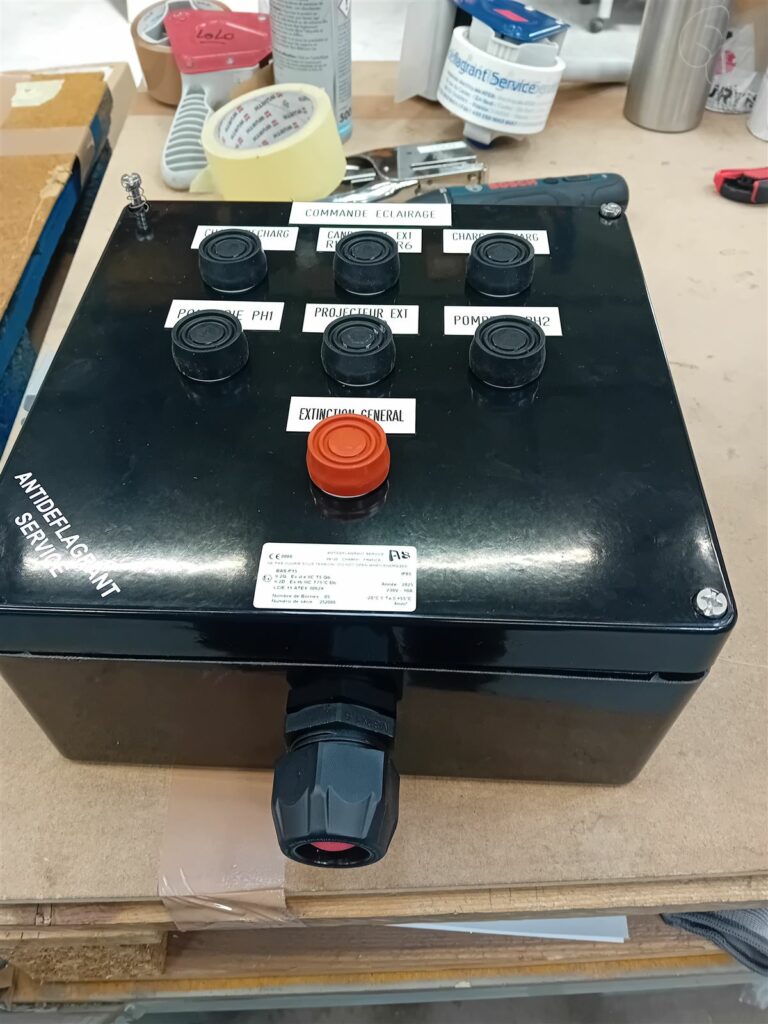
Increased safety prevents arcs, sparks or excessive temperatures, thanks to certified components and strict construction rules.
- For: junction boxes, terminal blocks, control stations with certified components.
- Points to watch: only Ex e compatible components can be fitted; also open only when de-energised, except Ex i circuits.
Comparison
| Criterion | Ex d | Ex e |
|---|---|---|
| Principle | Contain the explosion | Prevent ignition |
| Possible contents | Spark-producing equipment | Terminals, certified components |
| Weight | Higher | Lighter |
| Materials | Aluminium alloy, cast iron, 316L stainless steel | Polyester, aluminium alloy, 316L stainless steel |
| Our ranges | DAS, CAS, EJB, EJC | BAS-P, BAS-A, BAS-I |
Why not both?
Many assemblies combine an Ex d enclosure for the equipment and an Ex e box for the connections. Our design office will propose the best combination.